

With my latest beret design, named Nedging, I wanted to evoke the styles of the 1940s”
The new year has got off to a damp and windy start in rural Suffolk. As I write, the sky is a pallid silver-grey, and mist from the rain is blurring the horizon, softening what are usually far-reaching views stretching into the distance across the ploughed fields and grazing meadows.
Today from my studio, I can instead see disgruntled pigeons perched in the trees, facing the prevailing wind and looking generally miserable. Thankfully though, the weather doesn’t dampen my enthusiasm for designing and indeed encourages me to hunker down in the warm and work on cosy new designs for Charlie’s Aunt, that will see me through the colder winter months. Top of the list this year is my stock of beret hats.

When I do venture out, it also gives me a chance to ‘road test’ samples of my new designs – especially the hats. I am a big fan of berets – borne out by the fact that I already have two beret patterns in my pattern collection, and another two in the pipeline for 2024! I think their shape lends itself well to both practical and dressy versions, and I’ve found berets suit most face shapes, depending on how they are worn. Plus, they are not too difficult to make. To celebrate my love of berets, one of my most popular designs, the Lavenham Beret, is one of January’s ‘patterns of the month’.
History of berets
Briefly, in terms of the history of the beret, they are traditionally soft, round, flat peakless caps which were popularized in France during the 1800s. The armed forces also adopted berets as part of their uniform over the years. One of the few photos I have of my dear father during his years of national service in the RAF, circa early 1950s, shows him on parade with his squadron and wearing the full uniform, including beret. I recently acquired this photo from my aunt who also gave me a Christmas card dad sent his family while he was stationed away from home. She gave me a lovely heart shaped RAF brooch he sent to his mother, my grandma Daisy, who I never met as she very sadly passed away before I was born. Dad always said I inherited my pattern drafting skills from Daisy. She was very skilled at making clothing for dad and his seven siblings without the aid of any patterns. The heart brooch has such significance and I will always treasure it.

Getting back to berets, the Scots have their own version of the style, known as the tam-o’-shanter. But, the berets that inspire me most are those that were popular in the 1930s and 40s, ranging from wonderful soft Fairisle knitted models to molded felt berets with a multitude of trims. My designs, I always think, fall somewhere between the two. Soft and cosy, but with structure and modernized enough to make them practical to wear and sew.
The new designs for 2024
Berets are also relatively simple styles to make and are certainly not beyond a novice hat-stitcher. This is largely because they don’t have to be interfaced, due to the desired ‘squishy’ appearance, and can be made from fairly small pieces of fabric. You can also go to town with the linings, with anything from soft silk to pretty vintage cottons.

With my latest beret design, named Nedging, I wanted to evoke the styles of the 1940s in a simple pattern that could be trimmed in various ways. In addition, it can also be worn two ways, either with the band ‘down’ and the top ‘scrunched’ over to one side at a jaunty angle, or with the band tucked up inside.


The camel version pictured above is made in a classy but cuddly soft wool-touch fabric and has a simple self-fabric bow in the centre of the crown top. I’ve worn this a lot already this season. The wool polka-dot version has a truly 1940s vibe and is trimmed with a decorative tab and vintage buckle. I love this version – particularly in this fabric – and will be offering kits for it. It just has that nostalgic vintage feel that I yearn for and is one of those designs that I instantly loved as soon as it had its final pressing. I hope you like it as much as I do. There will be a third trim option which I will be sampling shortly.
More berets!
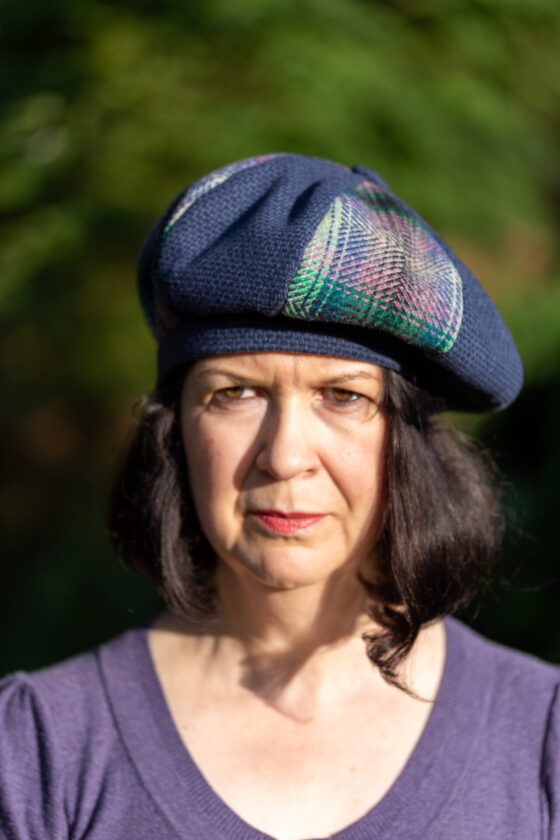


In addition to Nedging, I have already given a sneak preview of the Groton Beret, which is made using eight separate sections and looks fabulous in contrasting fabrics. I found some wonderful lining from Free Spirit fabrics which toned well with my wool-rich tweeds (available in the Charlie’s Aunt Etsy shop). I’m very pleased with both styles and can’t wait to be able to offer PDF patterns and full kits for them.

If you can’t wait for the new patterns, then you can purchase two of my most popular hat patterns, the Lavenham Beret, currently January 2024’s ‘Pattern of the Month’ in the Charlie’s Aunt Etsy shop. Or if you’d prefer, there is the slightly larger fabric rose-trimmed Burnham Beret.

As always, email emma@charliesaunt.com if you have any questions.
Happy winter sewing!
Emma xx


